
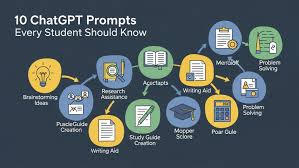
ChatGPT can be a powerful study buddy for students. It helps explain complex ideas, brainstorm essay topics, and even check your writing. Learning how to ask the right questions (prompts) makes all the difference.
This guide offers clear ways for students to use ChatGPT effectively for better grades and understanding.
Understanding How ChatGPT Helps Students
ChatGPT is a smart computer program. It can understand and create human-like text. Think of it like a very helpful assistant.
It has read a lot of information from books and the internet. So, it knows about many subjects. When you ask it a question, it uses what it learned to give you an answer.
It can explain things in simple terms. It can also give you ideas for projects. It’s a tool to help you learn and think.
For students, this means many new ways to study. You can get help with homework. You can learn about things you find tricky.
You can even practice for tests. The key is telling ChatGPT exactly what you need. This is done with a chatgpt prompt.
A good prompt is like a clear instruction. It guides the AI to give you the best possible help. It’s about knowing what to ask.
Many students feel stuck sometimes. They might not understand a math problem. Or they might not know where to start on a history report.
ChatGPT can break down these problems. It can offer a starting point. It can also help you see a topic from different sides.
This makes learning less of a chore and more of an adventure. It’s like having a tutor available anytime.
Personal Experience: The Essay Outline Nightmare
I remember one time in college. I had a big essay due in my English class. The topic was about symbolism in a novel.
I sat in front of my laptop, the cursor blinking mockingly. I knew the book, but my mind was blank. How could I possibly create a strong argument?
I felt a wave of panic. I started typing random ideas, but nothing clicked. It felt like I was trying to build a house without any tools.
The blank page was my enemy.
Then, I remembered I had been playing around with ChatGPT. I thought, “What if I ask it for help with an essay outline?” I typed: “Give me an essay outline for symbolism in by .” The response was pretty good. It suggested main points and sub-points.
It wasn’t perfect, but it was a solid structure. It gave me the skeleton I needed. I could then fill in the details with my own thoughts and research.
That feeling of being completely lost vanished. I felt a surge of relief. The essay outline was no longer a scary monster.
This experience showed me how powerful prompts can be. Before, I just asked vague questions. But when I got specific about what I needed – an essay outline – ChatGPT delivered.
It was the difference between a jumble of words and a clear path forward. It taught me that the tool is amazing, but the way you ask matters even more. It made me realize how much time and stress I could save by asking the right way.
Crafting Effective ChatGPT Prompts for Students
The most important part of using ChatGPT is the prompt. Think of your prompt as a recipe. The better the recipe, the better the dish.
For students, this means being specific. Don’t just ask “Tell me about the Civil War.” That’s too broad. You’ll get a lot of general information.
You want answers tailored to your schoolwork.
Here are some ideas for making your prompts better:
1. Be Clear About Your Goal
What do you want to achieve? Do you need an explanation? Do you need ideas?
Do you need help practicing? State this clearly in your prompt. For example, instead of “History facts,” try “Explain the main causes of the French Revolution in simple terms for a high school student.”
2. Provide Context
Tell ChatGPT about your situation. What grade are you in? What class is this for?
What have you already learned? This helps it give you the right level of detail and complexity. For instance, “I am a 7th grader learning about fractions.
Explain how to add fractions with different denominators. I already know how to find a common denominator.”
3. Specify the Format
Do you need a list? A paragraph? A table?
A summary? Tell ChatGPT how you want the answer presented. “List three main themes in ‘To Kill a Mockingbird’ with a short explanation for each.” Or “Create a table comparing the advantages and disadvantages of solar power.”
4. Ask for Examples
Examples make learning much easier. If you’re learning a new concept, ask for examples. “Give me three examples of metaphors in everyday speech.” Or “Show me an example of a quadratic equation being solved step-by-step.”
5. Request Different Perspectives
Sometimes, understanding a topic means seeing it from multiple angles. You can ask ChatGPT to explain something as if you were someone else. “Explain photosynthesis as if you were a plant.” Or “Describe the impact of the printing press from the perspective of a medieval scribe.”
Prompting Tip: The “Act As” Technique
You can tell ChatGPT to adopt a specific persona. This helps it tailor its response. Try starting your prompt with phrases like:
- “Act as a history professor.”
- “Imagine you are a science tutor.”
- “Pretend you are a college admissions counselor.”
This sets the tone and expertise level for the AI’s answer.
ChatGPT Prompts for Understanding Difficult Concepts
This is where ChatGPT can be a game-changer. When a teacher explains something, and it just doesn’t click, it’s frustrating. You might feel left behind.
ChatGPT can re-explain things in ways that make sense to you.
Here are prompts for understanding tough subjects:
Science Explanations
- “Explain the process of cellular respiration using a simple analogy suitable for a 9th grader.”
- “What is quantum entanglement? Explain it as if I am a curious teenager with no physics background.”
- “Describe the water cycle. Break it down into the main stages with one sentence for each.”
- “What are the key differences between mitosis and meiosis? Present them in a bulleted list.”
- “Explain the theory of relativity in very simple terms. Focus on the core ideas, not the math.”
Math Problems
- “I’m stuck on solving linear equations. Show me a step-by-step solution for this problem: 3x + 5 = 14.”
- “Explain the Pythagorean theorem. What is it used for? Give a simple example.”
- “How do you find the area of a triangle? Provide the formula and an example calculation.”
- “What is probability? Give me three real-world examples of probability in action.”
- “Explain the concept of logarithms. What do they mean? Show me a basic example.”
Quick Scan: Science Concept Explainer Prompts
| Concept | Prompt Idea | Target Audience |
| Photosynthesis | Explain photosynthesis like I am a houseplant. | Beginner |
| Gravity | What is gravity? Use a simple analogy for a child. | Young Learner |
| DNA | Describe DNA’s role in heredity. Keep it to 3 short sentences. | High School |
History and Social Studies
- “Summarize the main reasons for the fall of the Roman Empire. Focus on economic and social factors.”
- “Explain the concept of supply and demand. Use a scenario involving video games.”
- “What were the key events of the Civil Rights Movement in the 1960s? List them chronologically.”
- “Describe the impact of the Industrial Revolution on everyday life in the 19th century.”
- “What is democracy? Explain its core principles in simple terms.”
Literature and Language Arts
- “Explain the literary device ‘irony.’ Give me three distinct examples from literature or movies.”
- “What is a simile? Provide five examples of similes I could use in my writing.”
- “Summarize the plot of ‘Romeo and Juliet’ in 100 words or less.”
- “What are the main themes in Shakespeare’s ‘Hamlet’? Explain each theme briefly.”
- “How can I improve my descriptive writing? Give me three specific tips.”
ChatGPT Prompts for Writing Assistance
Writing essays, reports, and even emails can be tough. You might stare at a blank page. Or you might finish writing but feel unsure if it’s good.
ChatGPT can help at many stages of the writing process.
Brainstorming and Idea Generation
Stuck for ideas? ChatGPT can be a fantastic brainstorming partner. Don’t let the blank page win.
- “Brainstorm 10 potential essay topics for a 10th-grade history class on World War II.”
- “Give me 5 creative project ideas for a science fair project about renewable energy.”
- “I need to write a persuasive essay about the benefits of recycling. What are some strong arguments I could use?”
- “Suggest some interesting angles for a book report on ‘The Great Gatsby’.”
- “Help me brainstorm a catchy title for a presentation on climate change.”
Insight Panel: Brainstorming Helper
Problem: Creative block.
ChatGPT Solution: Ask for lists of ideas, different angles, or potential arguments. Specify the subject and audience.
Example Prompt: “Brainstorm 5 story ideas for a science fiction short story competition. The story should involve artificial intelligence and a moral dilemma.”
Outlining and Structuring
Once you have ideas, you need to organize them. An outline is like a roadmap for your writing.
- “Create a detailed outline for an essay arguing that schools should start later in the day. Include an introduction, three body paragraphs with supporting points, and a conclusion.”
- “Provide a basic structure for a research paper on the effects of social media on teenagers.”
- “Help me outline a persuasive speech about the importance of voting for young adults.”
- “I’m writing a proposal for a school club. What sections should I include in the proposal document?”
- “Generate a possible outline for a creative writing piece about a talking animal who travels through time.”
Improving Clarity and Style
Even after writing, your work might not flow well. Or it might be hard to understand. ChatGPT can help refine your words.
- “Review this paragraph and suggest ways to make it clearer and more concise: .”
- “Are there any repetitive phrases in this text? Suggest alternatives: .”
- “Make this sentence more engaging: ‘The dog was big and furry.'”
- “Help me rephrase this sentence to sound more formal: ‘We gotta finish this project soon.'”
- “Suggest stronger verbs to replace ‘walked’ and ‘said’ in this story.”
Contrast Matrix: Rewriting vs. Writing
Myth: ChatGPT can write your essay for you.
Reality: ChatGPT is a tool to assist your writing. It helps brainstorm, outline, and refine. You must do the actual writing and critical thinking.
Myth: Using ChatGPT for writing help is cheating.
Reality: Using ChatGPT ethically for brainstorming, outlining, and grammar checks is like using a spell checker or thesaurus. It’s about learning to use tools responsibly.
Grammar and Proofreading Checks
While not a perfect editor, ChatGPT can catch many errors.
- “Check this text for grammar and spelling errors: .”
- “Are there any punctuation mistakes in this sentence? .”
- “Identify any instances of passive voice in this paragraph and suggest active voice alternatives: .”
- “Explain why ‘affect’ and ‘effect’ are different. Give me an example of each.”
- “Is this sentence grammatically correct? .”
ChatGPT Prompts for Test Preparation
Tests can cause a lot of stress. Practicing with questions helps you feel more confident. ChatGPT can create practice questions for you.
Creating Practice Questions
- “Create 10 multiple-choice questions about the American Revolution. Include the correct answers.”
- “Generate 5 short-answer questions about the causes of World War I.”
- “Give me a practice essay question for a biology test on genetics.”
- “Create a quiz on the periodic table with 8 fill-in-the-blank questions.”
- “I have a test on algebra. Create 5 word problems that require solving for ‘x’.”
Quick-Scan Table: Test Prep Prompts
| Subject | Question Type | Prompt Example |
| History | Multiple Choice | Create 5 multiple-choice questions about ancient Egypt, with answers. |
| Math | Word Problems | Generate 3 word problems on percentages for a 7th grader. |
| Science | True/False | Make 4 true/false statements about the solar system. |
Explaining Answers
If you get a practice question wrong, you need to know why. ChatGPT can explain the correct answer.
- “I got this multiple-choice question wrong. The question was . The correct answer was . Can you explain why that answer is correct and why my choice was wrong?”
- “Explain the solution to this math problem: .”
- “Why is considered a turning point? I thought it was .”
- “Can you explain the science behind why happens? I don’t understand the explanation in my textbook.”
- “I answered to this question about . Can you explain the correct answer and why mine is not accurate?”
Summarizing Study Material
Sometimes, you just need the key points from a long chapter.
- “Summarize chapter 5 of my biology textbook on ecosystems. Focus on the key terms and their definitions.”
- “Give me the main arguments from the article . I need a quick overview.”
- “What are the most important concepts I need to know from a lecture on the causes of the American Civil War?”
- “Condense the key information about the French Revolution into bullet points.”
- “Provide a brief summary of the main characters and plot of ‘Lord of the Flies’.”
Observational Flow: Test Prep Strategy
Step 1: Identify Topic. What subject or chapter will be tested?
Step 2: Ask for Questions. Use ChatGPT to generate practice questions.
Step 3: Answer Questions. Try to answer them without looking up the material.
Step 4: Review Answers. Check your answers. If wrong, ask ChatGPT to explain why.
Step 5: Identify Gaps. See what you still don’t understand and ask for more explanations.
ChatGPT Prompts for Exploring Interests and Hobbies
School isn’t just about grades. It’s also about discovering what excites you. ChatGPT can help you learn about anything, even outside of class.
- “Tell me about the basics of stargazing. What are some easy constellations to find?”
- “Explain the rules of chess in a simple way.”
- “What are the different types of photography? Briefly describe each one.”
- “Give me some ideas for simple science experiments I can do at home with household items.”
- “What is the history behind popular video games like Minecraft or Fortnite?”
- “Explain the basics of coding using Python. Give me a very simple example of a program.”
- “Tell me about famous artists from the Renaissance period. Who were they and what are they known for?”
- “What are some common houseplants that are easy to care for?”
- “Explain the concept of a budget for teenagers. How can I start saving money?”
- “What are the different types of musical instruments? Group them by how they make sound.”
Ethical Use and Important Considerations
ChatGPT is an amazing tool, but it’s important to use it wisely. Think of it as a helpful friend, not someone who does your work for you.
Originality and Plagiarism
The biggest concern is academic honesty. Copying ChatGPT’s answers and submitting them as your own is plagiarism. Teachers can often detect this.
It’s crucial to use the AI as a starting point or a learning aid. Always put the information into your own words. Show your own understanding and critical thinking.
Your own voice is what matters most.
Accuracy of Information
While ChatGPT is very knowledgeable, it can sometimes make mistakes. It might misunderstand a question. Or it might provide outdated information.
Always double-check important facts, especially for school assignments. Compare its answers with trusted sources like textbooks or academic websites. Don’t rely on it blindly.
Think critically about what you read.
Stacked Micro-Sections: Responsible AI Use
Understand the Limits: AI isn’t always right. Be a fact-checker.
Cite Your Sources: If you use an idea from AI research, cite it if required by your teacher. Be upfront about your tools.
Develop Your Skills: Use AI to learn, not to replace learning. Practice writing and thinking yourself.
Ask for Clarification: If something is unclear, ask ChatGPT to explain it differently. Don’t just accept a confusing answer.
When to Ask a Teacher or Human
ChatGPT is great for many things, but it can’t replace a human teacher. If you’re feeling really confused, or if a topic is sensitive, talk to your teacher. They understand your specific class and needs.
They can offer personalized guidance and support. Sometimes, a real conversation is best for deep understanding.
What This Means for You
Knowing how to prompt ChatGPT opens up a world of learning opportunities. It means you can get help exactly when you need it. You can understand subjects better.
You can improve your writing skills. You can prepare for tests more effectively. And you can explore new interests.
It’s about using technology to make your education more effective and enjoyable. It’s about becoming a more independent and confident learner. By mastering these prompts, you’re not just using a tool; you’re enhancing your own abilities.
You’re building skills that will help you far beyond the classroom.
Quick Fixes & Tips
Here are some simple tips to remember:
- Start Simple: If you’re unsure, begin with a clear, simple question.
- Refine Your Prompt: If the answer isn’t quite right, rephrase your question. Add more details.
- Experiment: Try different ways of asking. See what works best for you.
- Save Good Prompts: Keep a list of prompts that give you great answers.
- Use Bold Text: Highlight key terms in your prompt to help ChatGPT focus.
- Ask for Simplification: If an answer is too complex, ask ChatGPT to “explain this in simpler terms” or “explain it like I’m 10.”
Frequently Asked Questions
Can ChatGPT help me write my entire essay?
ChatGPT can help brainstorm ideas, create outlines, and suggest ways to improve your writing. However, writing the entire essay for you is considered plagiarism. It’s best to use it as a tool to assist your own writing process, ensuring you put the final work into your own words and thoughts.
Is it okay to use ChatGPT for homework help?
Yes, it’s generally okay to use ChatGPT for homework help if you use it responsibly. This means using it to understand concepts, check your work, or get ideas. It’s not okay to copy and paste answers directly and submit them as your own. Always aim to learn from the tool.
How do I know if the information from ChatGPT is correct?
ChatGPT can sometimes make mistakes. Always cross-reference important information with reliable sources like your textbooks, class notes, or reputable websites. Treat its answers as a starting point and verify critical facts.
Can ChatGPT help me study for tests in any subject?
Yes, ChatGPT can be a great study aid for many subjects. You can ask it to explain concepts, generate practice questions, create quizzes, or summarize study materials for subjects like math, science, history, literature, and more.
What is the best way to ask ChatGPT for writing feedback?
To get the best writing feedback, paste the specific text you want reviewed and ask clear questions. For example, “Can you check this paragraph for grammar errors?” or “How can I make this sentence more active?” or “Suggest alternative words for ‘good’.”
Will my teacher know if I used ChatGPT?
Some plagiarism detection tools can identify AI-generated text. More importantly, your teacher can often tell if the writing doesn’t sound like you or if it lacks your personal understanding. It’s always best to be honest and use AI as a learning tool rather than a replacement for your own work.
Conclusion
Using ChatGPT effectively as a student means knowing how to ask. By crafting clear, specific prompts, you can unlock its full potential. It’s a powerful ally for understanding complex topics, improving writing, and preparing for exams.
Embrace this tool responsibly, and watch your learning grow.







Leave a Reply