
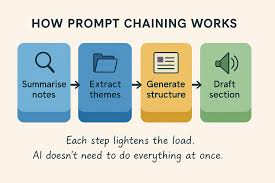
This guide will break down prompt chaining. We’ll look at what it is, why it helps, and how you can use it. You’ll learn to build more complex requests for AI.
This will make your AI interactions much more powerful.
Prompt chaining involves breaking down a complex task into smaller, sequential prompts for an AI. Each prompt builds on the output of the previous one, guiding the AI towards a more refined and accurate final result. This method helps overcome limitations of single, large prompts.
What is Prompt Chaining?
Imagine you want an AI to write a story. A single prompt might be: “Write a sci-fi story about a lost robot finding a new home.” The AI might give you something decent. But what if you want specific details?
What if the robot needs a personality? What if the new home should be on a strange planet?
Prompt chaining lets you do this piece by piece. You could start with a prompt for the robot’s personality. Then, use that description in a second prompt to start the story.
Next, you might ask the AI to describe the strange planet. You keep adding steps, linking them together. Each step uses the work from the step before it.
Think of it like building with LEGOs. You don’t just dump all the bricks and expect a castle. You pick a base, add walls, then a roof.
Prompt chaining is that careful building process for AI tasks. It’s a way to manage complexity. It lets you control the output more precisely.
Why Use Prompt Chaining?
Using a single prompt for everything can be tricky. AI models can get confused by too many instructions at once. They might miss some details.
Or they might mix up different parts of the request. Prompt chaining helps avoid these issues. It offers several key benefits for your AI work.
First, it improves accuracy. When you break down a task, each step is simpler. The AI can focus on doing one thing well.
This leads to better results overall. Second, it allows for control. You can steer the AI’s thinking at each stage.
If an early step isn’t quite right, you can fix it before moving on. This saves time and effort later.
Third, it handles complex tasks. Some jobs are too big for one prompt. Writing a whole novel, generating detailed code, or creating a full marketing plan are examples.
Chaining these tasks into smaller parts makes them manageable. You can build up to the final, large output.
Finally, it’s a great way to learn and debug. If your AI isn’t giving you what you want, you can look at each step of your chain. You can see exactly where things went wrong.
This helps you understand how the AI is interpreting your prompts.
Key Benefits of Prompt Chaining
- Better Accuracy: AI focuses on one clear task at a time.
- More Control: You guide the AI step-by-step.
- Handles Complexity: Breaks down big jobs into small steps.
- Easier Debugging: Pinpoint issues in your AI’s process.
- Refined Outputs: Build detailed and specific results.
How to Create a Basic Prompt Chain
Let’s start with a simple example. Imagine you want an AI to summarize a long article and then suggest three follow-up questions about it.
Step 1: The First Prompt (Summarization)
You’ll need the article text. Let’s say you paste it into your AI tool. Your first prompt might be:
“Please summarize the following text in three sentences or less: “
The AI will read the article and give you a short summary. This is the output of your first prompt.
Step 2: The Second Prompt (Follow-up Questions)
Now, you take the summary the AI just gave you. You use this summary as part of your next prompt. You want the AI to ask questions based on this summary.
Your second prompt could look like this:
“Based on the following summary, please suggest three thoughtful questions for further discussion: “
By including the summary in the second prompt, you’re telling the AI what information to focus on. You’re not asking it to re-read the whole article. You’re telling it to think about the condensed version.
The AI will then generate three questions.
This is a simple, two-step chain. You’ve taken a task (summarize and ask questions) and split it. Each prompt is clear and focused.
The second prompt directly uses the output of the first. This is the core idea of prompt chaining.
Simple Chain Example: Article Analysis
Prompt 1 Input: Long article text.
Prompt 1 Output: 3-sentence summary.
Prompt 2 Input: The 3-sentence summary from Prompt 1.
Prompt 2 Output: Three follow-up questions.
My Own Experience with Early Prompting
I remember trying to get an AI to write a recipe for me. I wanted something simple, for beginners. My first prompt was something like: “Write a recipe for chocolate chip cookies.” The AI gave me a recipe.
It was fine, but it used terms I didn’t understand like “creaming the butter and sugar” and “folding in the flour.” It felt a bit too advanced for someone who had never baked before.
I felt a little frustrated. I knew what I wanted, but the AI wasn’t quite there. So, I decided to try chaining.
My first prompt became: “Write a list of common baking terms used in cookie recipes, and explain them simply for a beginner.” The AI gave me a list with clear, short explanations. Terms like ‘creaming’ and ‘folding’ were now easy to grasp.
Then, I used that new knowledge for my second prompt. I said: “Now, write a simple chocolate chip cookie recipe for a complete beginner. Assume they don’t know baking terms.
Use only very easy steps and words.” The AI produced a recipe that was perfect for me! It was clear, step-by-step, and didn’t assume any prior knowledge. That experience taught me the power of breaking things down.
Advanced Prompt Chaining Techniques
Once you get the hang of basic chains, you can build much more sophisticated ones. These techniques help you tackle bigger projects and get more specific results. They involve creating longer sequences, using intermediate outputs creatively, and managing information flow.
Chains with Multiple Steps
You can link more than two prompts together. For example, to write a blog post:
- Prompt 1: Generate 5 blog post ideas about healthy eating.
- Prompt 2: Choose the best idea from the list and write a catchy title for it.
- Prompt 3: Create an outline for a blog post with that title, including an intro, three main points, and a conclusion.
- Prompt 4: Write the introduction for the blog post based on the outline.
- Prompt 5: Write the first main point, expanding on it with details and examples.
- Prompt 6: Write the second main point.
- Prompt 7: Write the third main point.
- Prompt 8: Write the conclusion, summarizing the main points.
- Prompt 9: Review the whole post for flow and clarity.
Each prompt uses the output from the one before it. This builds the content layer by layer. It’s much more controlled than asking for a full blog post at once.
Iterative Refinement
Sometimes, the AI’s output isn’t perfect on the first try. Iterative refinement means using prompts to fix or improve previous outputs. You don’t just accept the answer; you guide it to be better.
For example, if an AI generated a paragraph that was a bit too dry, your next prompt might be: “Make this paragraph more engaging by adding a personal anecdote or a surprising fact.” Or, if a response was too long, you could say: “Condense this explanation into two sentences, focusing only on the most critical information.”
Conditional Logic (Simulated)
While AI models don’t have true “if/then” logic built into prompts, you can simulate it. You can create prompts that check for certain conditions in the previous output and act accordingly.
For instance, you could prompt the AI to first identify the sentiment of a piece of text. Then, in the next prompt, you might say: “If the sentiment is positive, suggest ways to amplify it. If it’s negative, suggest ways to address it.” You provide the output of the sentiment analysis to the AI in the second prompt.
Chaining Styles at a Glance
Linear Chains
Step 1 -> Step 2 -> Step 3.
Good for sequential tasks like writing an article.
Iterative Chains
Step 1 -> Step 2 (Refine) -> Step 3 (Refine).
Best for improving an initial output.
Branching Chains (Simulated)
Step 1 -> Analyze Step 1 -> (If A, then Step 2A) OR (If B, then Step 2B)
Useful for dynamic responses based on intermediate results.
Real-World Scenarios Where Prompt Chaining Shines
Prompt chaining isn’t just for theoretical tasks. It’s incredibly useful in many practical, everyday scenarios. Think about your own work or hobbies.
Where could breaking down a task help you use AI better?
Content Creation and Marketing
Marketers and content creators often need to produce a lot of material. Prompt chaining can help generate blog posts, social media updates, email newsletters, and ad copy. You can chain prompts to brainstorm ideas, write outlines, draft content, and even suggest headlines or calls to action.
This saves immense time compared to writing everything from scratch or relying on one huge prompt.
Programming and Development
For coders, prompt chaining can assist in generating code snippets, explaining complex code, or even debugging. You might ask an AI to explain a function, then ask it to write a test case for that function, and then perhaps ask it to refactor that test case for better readability.
I’ve seen developers use chains to generate boilerplate code for new projects. They’d prompt for a basic structure, then add prompts for specific modules or error handling. This speeds up the initial setup significantly.
Research and Analysis
When dealing with large amounts of text, like research papers or customer feedback, prompt chaining is invaluable. You can use a chain to extract key information, summarize findings, identify themes, and even draft reports. For example, you might ask an AI to identify all mentions of a specific topic in a document, then ask it to summarize those mentions, and then ask it to categorize them.
Education and Learning
Students and educators can use prompt chaining to create study guides, explain complex concepts in simpler terms, or generate practice questions. A student might ask an AI to explain a scientific theory, then ask for an analogy to help understand it, and then ask for a quiz to test their knowledge.
Prompt Chaining in Action: A Quick Scan
| Area | Task Example | Chain Steps |
|---|---|---|
| Marketing | Write a Facebook ad | Brainstorm product benefits -> Write headline options -> Draft ad copy -> Suggest a call to action |
| Coding | Create a Python function | Describe function purpose -> Generate basic function code -> Add error handling -> Write docstrings |
| Research | Analyze survey results | Extract common themes -> Summarize each theme -> Identify outliers -> Draft executive summary |
| Education | Learn about photosynthesis | Explain photosynthesis basics -> Provide a simple analogy -> Generate 5 quiz questions -> Explain answers |
What This Means for Your AI Interactions
Understanding prompt chaining changes how you interact with AI. Instead of thinking of a single command, you start thinking about a process. You become a director, not just a question-asker.
When it’s normal: It’s normal to use simple, one-step prompts for simple tasks. If you just need a quick definition or a short piece of information, one prompt is usually enough. Don’t overcomplicate things when they don’t need it.
When to worry (or rather, when to chain): You should consider chaining when your prompt is long and has many parts. If you feel like you’re listing too many requirements. If the AI’s output is inconsistent or misses key details.
If the task itself is complex and multi-faceted.
Simple checks: Before you start a complex task, ask yourself: “Can I break this down into smaller, logical steps?” If the answer is yes, then prompt chaining is likely a good approach. Think about the information flow. What does the AI need to know at each stage?
The goal is to make the AI’s job easier and your results better. Prompt chaining helps achieve this by providing structure and clarity. It transforms AI from a guessing game into a more predictable tool.
Quick Tips for Effective Prompt Chaining
Getting the most out of prompt chaining involves a few smart practices. These tips will help you build chains that work well and give you the results you need. They focus on clarity, structure, and iterative improvement.
- Start Simple: Always begin with a clear goal for each individual prompt in your chain. What one thing should this prompt accomplish?
- Use Clear Labels: When you pass information from one prompt to the next, label it. For example, instead of just pasting text, you might say “Here is the summary:” or “Based on the outline provided:”.
- Be Specific in Instructions: For each prompt, tell the AI exactly what you want. “Summarize,” “List,” “Explain,” “Rewrite,” “Generate.”
- Review Each Step: Don’t just run the whole chain blindly. Look at the output of each prompt. If it’s not right, fix it before you move to the next step.
- Keep Prompts Focused: Avoid putting too many unrelated instructions into a single prompt. This defeats the purpose of chaining.
- Experiment: Not all chains will work perfectly the first time. Try different ways of phrasing your prompts or changing the order of steps.
- Document Your Chains: For complex chains, it can be helpful to write down the steps. This way, you can reuse them later or explain them to others.
Prompt Chaining Best Practices
Be Clear
State exactly what each prompt should do.
Be Specific
Use action verbs: List, Summarize, Explain.
Review & Refine
Check output at each step.
Experiment
Try different prompt wording and orders.
Frequently Asked Questions About Prompt Chaining
What is the main goal of prompt chaining?
The main goal is to improve the quality and accuracy of AI outputs for complex tasks by breaking them down into smaller, manageable steps. It allows for more control and refinement.
Can I use prompt chaining with any AI model?
Yes, prompt chaining is a general technique that works with most advanced large language models (LLMs) like GPT-3, GPT-4, Bard, Claude, and others. The interface or tool you use might affect how easy it is to implement.
How do I pass information from one prompt to the next?
You typically copy the output of the previous AI response and paste it into the prompt for the next step. Many AI interfaces allow you to reference previous turns in a conversation, which can automate this process.
What if an AI generates a wrong answer in the middle of a chain?
If an AI gives a wrong or unhelpful answer in an intermediate step, you should correct it or rephrase the prompt for that specific step. You can either edit the AI’s output or provide a new prompt that guides it to the correct information before proceeding.
Is prompt chaining the same as few-shot prompting?
No, they are different. Few-shot prompting involves giving the AI examples of input-output pairs within a single prompt to show it how to respond. Prompt chaining involves multiple, sequential prompts where the output of one becomes the input for the next.
How long can a prompt chain be?
Prompt chains can be very long, sometimes dozens of steps for highly complex tasks. However, very long chains can become difficult to manage and may increase the chances of errors accumulating. It’s often best to keep chains as short as effectively possible for the task.
Conclusion
Prompt chaining is a powerful technique. It helps you get more from your AI tools. By breaking down big jobs into small steps, you gain control.
You can guide the AI more precisely. This leads to better, more accurate results. Start experimenting with simple chains today.
You’ll see how much more you can achieve.










Leave a Reply